


Last updated: October 2026
Quick answer: There is no fixed number of CCTV cameras for a factory. The count comes from zones, not floor area. List every zone that must be watched, decide what each one has to prove, pick the lens for that distance, then add the recorder and disk. A 40,000 sq ft unit often lands between 16 and 24 cameras.
“Sir, it’s 50,000 square feet”
how many cameras will it take? That is the question almost every quotation starts with, and it is the wrong one. When planning cctv cameras for a factory,Two units of the same size can need 12 cameras or 30. The difference is not the area. It is how many gates, how much stock, how tall the racks, and whether you want to see that a person was there or see who that person was.
Here is the method we use on site, in the order we use it.
The short answer: how many CCTV cameras for a factory?
Most small and mid-size plants in India end up between 8 and 32 cameras. A 40,000 sq ft packaging or engineering unit with two gates usually lands between 16 and 24.
Treat that as a sanity check, not an answer. The correct number of CCTV cameras for a factory comes out of the five steps below, and by the end you will have a count you can defend to your directors.
Step 1: List the zones, not the square feet
Walk the site and write down every place where something enters, leaves, or goes missing. That list is your real brief.
| Zone | Why it needs a camera | Typical count |
|---|---|---|
| Main gate | People and vehicles in and out | 2 (one wide, one at face height) |
| Material gate or loading bay | Dispatch disputes, short loads | 2 per bay |
| Finished goods store | Highest value per square foot | 2 to 4 |
| Raw material store | Issue and return records | 1 to 2 |
| Production hall | Accidents, process checks | 1 per bay or aisle |
| Weighbridge | Weight disputes | 1 at plate height |
| Perimeter and yard | Boundary jumping, parking | 1 per 2 corners |
| Office block and server room | Access and asset cover | 1 to 2 |
A zone list of 14 rows gives you a camera count of 16 to 24 CCTV cameras for a factory of that shape. The list does the counting for you.
Step 2: Decide what each zone must prove
This is the step everybody skips, and it is the one that decides your budget.
There are four levels of detail, set out in the standard IEC 62676-4. Axis publishes the figures in its pixel density guide: detection needs about 25 pixels per metre, observation 63, recognition 125, and identification 250.
In plain words. A yard camera only has to show that someone walked through, so 25 px/m is enough. A gate camera that must let you tell a court who the person was needs 250 px/m, which means a tighter lens, a shorter distance, or another camera.
Mark each row of your zone list as detect, observe, recognise or identify. Suddenly you know which zones need two cameras instead of one.
Step 3: Pick the lens, then the count
A wider lens covers more ground with fewer cameras and gives you less detail. A narrower lens gives you detail over a smaller patch. That trade-off, repeated across your zone list, is your final number.
Two habits save money here. Make neighbouring coverage cones overlap, so each camera is itself watched by another. And use one tight camera at the choke point instead of three wide ones over an open floor, because everybody who steals something still has to walk out of a gate.
CCTV camera placement in factory sheds and yards
CCTV camera placement in factory buildings follows the light, not the wall that happens to be free.
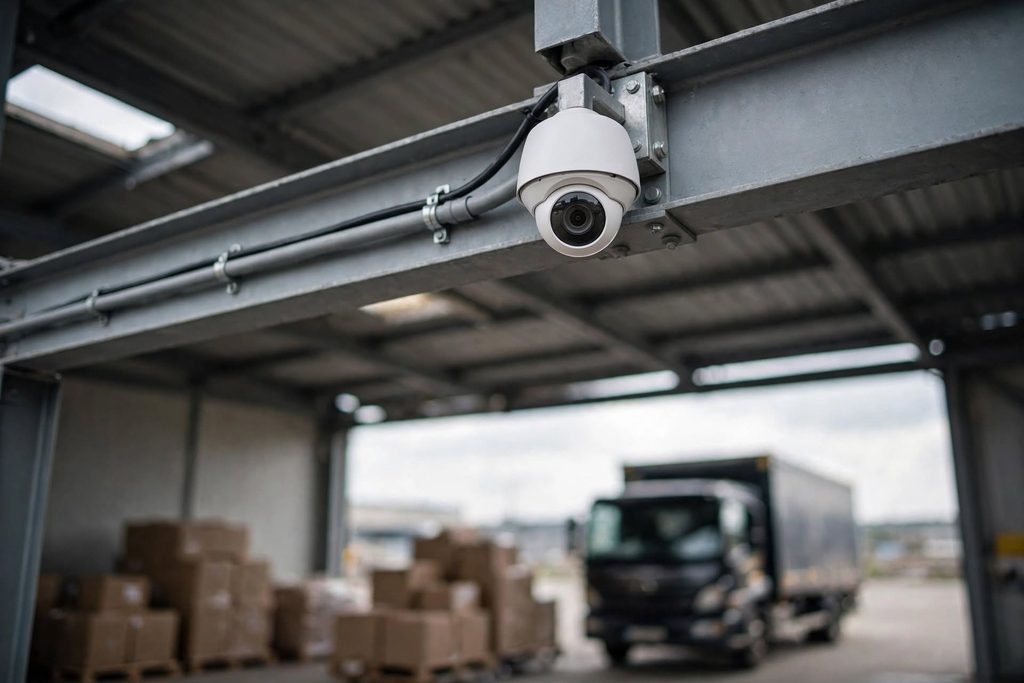
Properly designing cctv cameras for a factory shed requires pointing devices away from open shutters and skylights. A camera facing an open gate at 3 pm records a bright rectangle with a silhouette in it, which proves nothing. Mount at about 3 to 3.5 metres: high enough to be out of reach, low enough to catch faces instead of the tops of helmets.
For yards, CCTV camera placement in factory boundaries works best at corners looking along the fence line, not across the open ground.
Step 4: Size the recorder and the disk
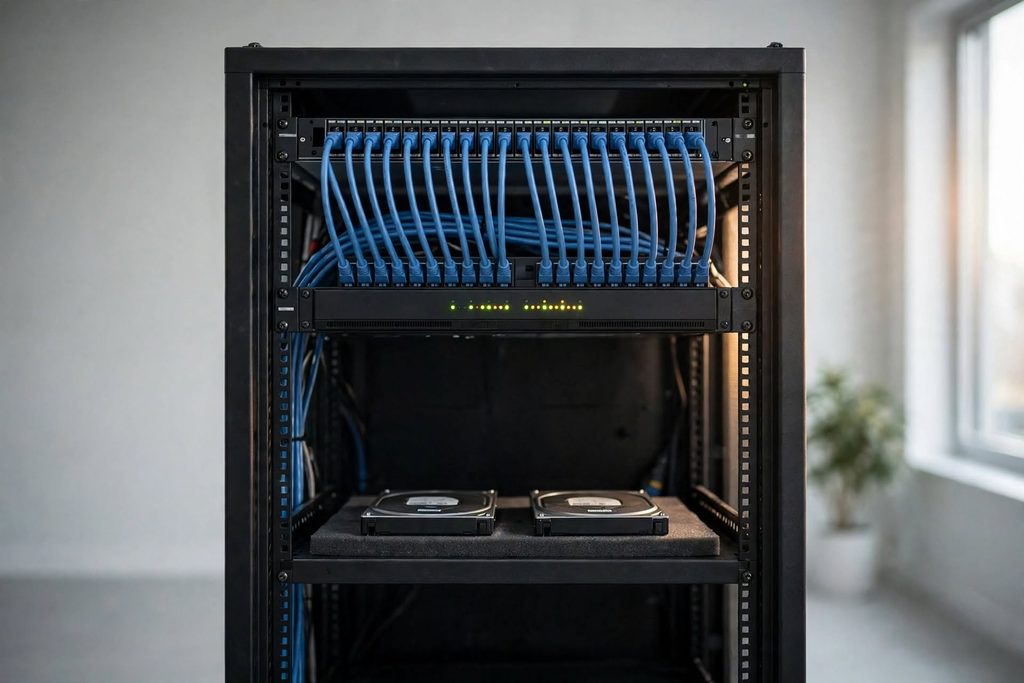
Match the recorder channels to your camera count with room to grow. A 20-camera plan goes on a 32-channel NVR, not a 16-channel one, because the next shed always comes.
Use the storage formula rather than a guess:
Storage (GB) = cameras × bitrate (Mbps) × 3600 × hours per day × days ÷ 8 ÷ 1024
Twenty cameras at 4 Mbps, recording all day for 30 days, works out to roughly 25 TB. Switch those cameras to H.265 at about 2 Mbps and the same system needs close to half that.
CCTV storage for 30 days: what decides the disk size
CCTV storage for 30 days is decided by four things: how many cameras, the bitrate of each, whether you record continuously or on motion, and the codec.
Two field rules. Use surveillance-rated drives such as Seagate’s SkyHawk range, because desktop drives are built for eight hours a day and a recorder writes for twenty-four. And check the actual retention on the recorder after one month, since planned CCTV storage for 30 days often turns out to be 18 once real motion levels kick in.
Step 5: Add the things people forget
Cameras are the cheap part. These four decide whether the system is still working next monsoon.
- Power. Put the NVR and the PoE switch on a UPS. A plant with daily voltage dips loses footage exactly when the trouble happens.
- Cable. Cat6 with a 100 metre limit per run, in conduit, with surge protection on any line leaving the building.
- Viewing. Decide now who watches, from which phone, and who holds the password.
- Cleaning. Dome covers in dusty units go milky within months. Build a quarterly wipe into your AMC or the footage quietly becomes useless.
A worked example: a 40,000 sq ft GIDC unit
Take a packaging unit with one main gate, one material gate, two sheds, a finished goods store and an office block.
Main gate 2, material gate and loading bay 3, finished goods store 3, raw material store 1, shed one 3, shed two 3, yard corners 2, office and server room 2. That is 19 cameras, on a 32-channel NVR, with roughly 25 TB of disk for 30 days at 4 Mbps.
Change one thing, the count moves. Add night dispatch and the gate needs a camera that can identify, not just detect. Add a weighbridge and that is one more. This is why a number quoted over the phone, before anyone has walked your site, is a guess.
How A&T Technologies counts CCTV cameras for a factory
A&T Technologies, an IT sales and service company in Vapi, Gujarat, works out CCTV cameras for a factory from a free site audit, not from your floor area. An engineer walks the gates and sheds, notes the light at each point, and marks zones on your layout.
You then get a camera position plan, a cable route, a recorder and storage figure, and a written scope. That sits alongside the security and surveillance work and network cabling we handle for plants across the belt.
FAQ about CCTV cameras for a factory
How many CCTV cameras for a factory of 10,000 sq ft?
A single-shed unit of that size with one gate usually needs 6 to 10 cameras: two at the gate, one or two in the store, two or three in the production area, and one covering the yard. The gate count rises if vehicles enter after dark.
Is 2 MP enough, or should a factory buy 4 MP cameras?
For detection across open floor, 2 MP still works and costs less in storage. For gates, weighbridges and store doors where you need to recognise a face or read a number plate, go to 4 MP or higher. Mixing the two across a site is normal practice
Do I need IP cameras or will analog work in a plant?
Analog on coaxial cable is cheaper for short runs and simple layouts. IP cameras on Cat6 make sense when you need higher resolution, longer runs, PoE power on one cable, and the option to add cameras later without pulling fresh coax everywhere.
How many days of CCTV footage should a factory keep?
Thirty days is the common commercial target, because theft, damage and dispatch disputes usually surface weeks later. There is no single national rule for every private factory, so check what your own customers, insurer and sector require before fixing the number.
Can I add cameras later to the same system?
Yes, if the recorder has spare channels, the switch has spare PoE ports and the disk has headroom. Plan all three with around 30 percent spare at purchase. Retrofitting a bigger recorder a year later costs far more than buying the larger one now.
Get your site counted properly
Send us your plant layout, or let an engineer walk the gates and sheds. You get a marked plan showing every camera position, the lens for each, the recorder size and the disk needed for your retention target.
Call or WhatsApp: +91 88660 33354 · Email: sales_india@a-ttechnologies.com
Office: D-311, 3rd Floor, M-Cube, Near Bombay Restaurant, Balitha, Vapi – 396195, Gujarat
Also read: WiFi solution for factory floors · Professional CCTV camera installation services in Gujarat